Instagram Followers by Country: Time Zones and Unfollows
By Shyview · · Updated · 6 min read
In this article7 sections
No public study shows that people in one country unfollow Instagram accounts faster than people in another. Claims like "Latin American audiences unfollow on impulse" or "Africa is the most loyal region" have no data behind them. What you can measure is where your followers live, when they're awake, and which of your posts lose followers. For an account with followers on several continents, time zones are the part you can measure and act on.
This guide covers where Instagram's audience is, what research says about why people unfollow, and how to use Insights to build a posting schedule that suits followers in more than one time zone.
Where Instagram's audience lives
Meta doesn't publish user counts by country. The closest public figure is ad reach: how many people advertisers can reach on Instagram in each country, as reported by Meta's own ad tools. DataReportal collects those numbers. In January 2025, Instagram ads reached 1.74 billion people, about 26.9% of everyone aged 13 and over.
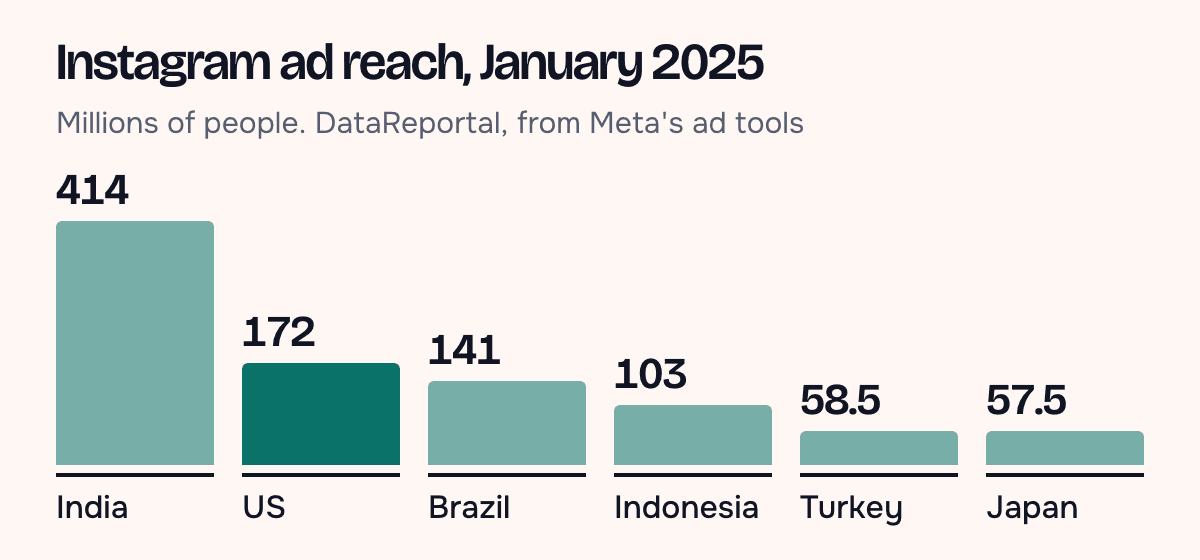
India leads with 414 million, then the United States with 172 million, Brazil with 141 million and Indonesia with 103 million. Turkey (58.5 million), Japan (57.5 million), Mexico (48.8 million) and the UK (33.4 million) follow. DataReportal warns that ad reach is "not a direct proxy" for active users, so read them as a rough size for each audience.
In the US, Pew Research Center found in 2025 that half of adults use Instagram, rising to eight in ten among those aged 18 to 29. Pew surveyed 5,022 adults between February and June 2025.
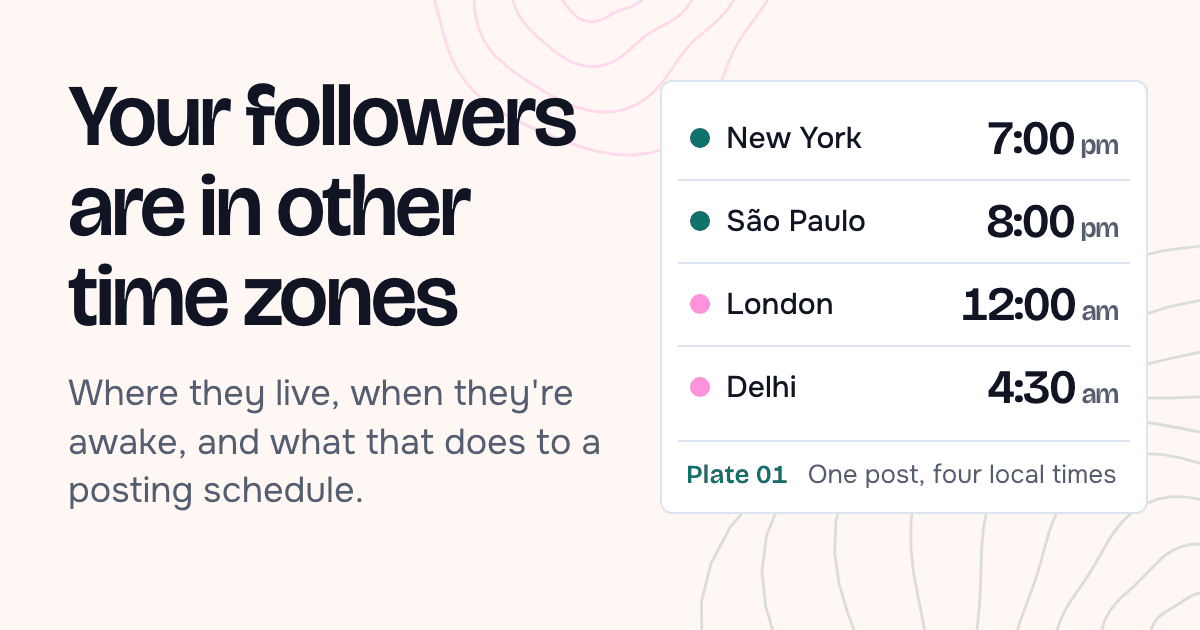
The practical point: an English-language account can easily have followers in New York, São Paulo, London and Delhi. Those cities span nine and a half hours of clock time.
What research says about why people unfollow
Large studies of unfollowing are rare, and none of them compares countries. One large study looked at Twitter. In 2011, a team of Korean researchers tracked 1.2 million Korean-speaking users for 51 days. About 30% of them unfollowed someone at least once; among active users the share rose to 43%.
When the team interviewed 22 people about why, the top answer was bursts. Twenty of the 22 had unfollowed someone for posting a lot in a short time. Eleven had dropped accounts for uninteresting topics, and eight for posting mundane details of daily life.
That study covers Twitter in 2011, and Instagram today is a different app. The finding still lines up with how a feed feels: a cluster of posts lands as one long run of the same face in someone's feed. And time zones make clusters worse. Five stories you post across an evening in New York arrive as a single stack for a follower in London who was asleep.
Find your followers' countries and active hours in Insights
Instagram shows your own followers by country for free. Any public account can use Insights, personal or professional. You need at least 100 followers to see the follower breakdown.
- Open Insights from your profile.
- Choose a time frame. Instagram offers the last 7, 14, 30 or 90 days; pick 30 or 90 so a single viral post doesn't skew the picture.
- Open Total followers.
- Read Top locations, by country and by city.
- Read Most active times, the hours and days your followers are on Instagram.
- Check Growth, which shows followers gained and lost for the period.
Write down your top three countries and the share each one holds. If one country holds most of your audience, schedule for it and stop there. If two or three are close, you have a time-zone problem worth solving.
Turn time zones into a posting schedule
Instagram doesn't name a best time to post. What it does say is that timing feeds into ranking.
Its ranking explainer lists "when a post was shared" among the signals, and an earlier post adds "how quickly other people are liking, commenting, sharing, and saving a post." A post that goes up while your biggest group of followers is asleep starts with fewer of those early interactions.

A 7 pm post in New York is an evening post in São Paulo, a midnight post in London and a 4:30 am post in Delhi. No single hour suits all four, so pick deliberately:
- Serve your biggest group first. If 45% of your followers are in the US and 15% in India, post at the US evening peak your Insights show.
- Find the overlap. Late morning in New York (around 11 am) is late afternoon in London. US East Coast and Western Europe share that window every day.
- Rotate when groups are even. Alternate posting times through the week so each group gets a post at its own peak.
- Space your stories. Spread a batch over the day instead of posting five in ten minutes. That is the "burst" behavior the Twitter study found people dislike.
Instagram's own scheduler handles the rest. A public account can schedule up to 25 posts a day, up to 30 days in advance, including reels, photos and carousels. Collabs, product tags and paid partnerships can't be scheduled, so post those by hand.
One trap to watch: daylight saving.
The US moves its clocks on the second Sunday of March and the first Sunday of November; the EU on the last Sundays of March and October; India and Brazil don't change at all.
So for about three weeks in March and one week at the end of October, New York sits four hours behind London instead of five, and posts you scheduled for London's evening land an hour off.
Spot which posts cost you followers
Insights won't name the people who left, but the Growth view shows how many you gained and lost. Check it the day after each post for a month. You're looking for a pattern: a dip after posts in one language, after a topic change, or after a run of stories.
When a pattern shows up, check relevance before you blame a country. A post about a US holiday means little to followers in Jakarta. That doesn't mean you should stop posting it. It means a regional post should be one post among many, with a caption that explains why it matters.
Language works the same way. If a large share of your top locations is outside the English-speaking world, a short translated line in the caption, or a reply in the follower's language, costs you a minute and shows you noticed them.
Learn from accounts in your followers' countries
The fastest way to learn what works in another market is to watch accounts that already do well there. You don't need to follow them to do it.
Stories show their timing best. The anonymous story viewer opens a public account's current stories and shows how long ago each one went up, so you can see when a creator in Mumbai or Mexico City posts.
For audience size, the Instagram profile viewer shows a public account's follower and following counts.
For what travels, the Instagram reels viewer lists each public reel with its plays and likes, which shows the kind of video that does well in that market.
Look at three or four accounts in each of your top countries. Note when they post, how long their captions run and which language they use. That's a better guide than any generalization about a whole country's character.
FAQ
Do people in some countries unfollow more than others?
There's no public data showing that. The research that exists looks at why individuals unfollow, and it points to posting bursts and uninteresting or overly personal content. Country-by-country loyalty tables you see online are not based on published studies.
Can I see where my followers live without a professional account?
Yes, if your account is public and has at least 100 followers. Insights shows top countries and cities, and the hours your followers are most active.
What's the best time to post for a global audience?
The peak hours of your largest follower group, from Insights. If two groups are close in size, use the hours where their days overlap or alternate between their peaks.
Does posting time affect the algorithm?
Instagram lists when a post was shared and how quickly people interact with it among its ranking signals. A post that goes up when your followers are awake has a better chance of early likes, comments and shares.
Does Instagram tell me who unfollowed me?
No. Insights shows how many followers you gained and lost in a period, without names. To see names, export your follower list from Instagram twice and compare the two.