Instagram Follower Ratio: What's Good and How to Fix It
By Shyview · · Updated · 9 min read
In this article9 sections
- How to calculate your follower ratio
- What counts as a good follower to following ratio
- Does Instagram's algorithm care about your ratio?
- Who looks at your ratio
- The number brands check next: engagement rate
- How to improve your ratio without gaming it
- Track your ratio month by month
- Checking someone else's ratio
- FAQ
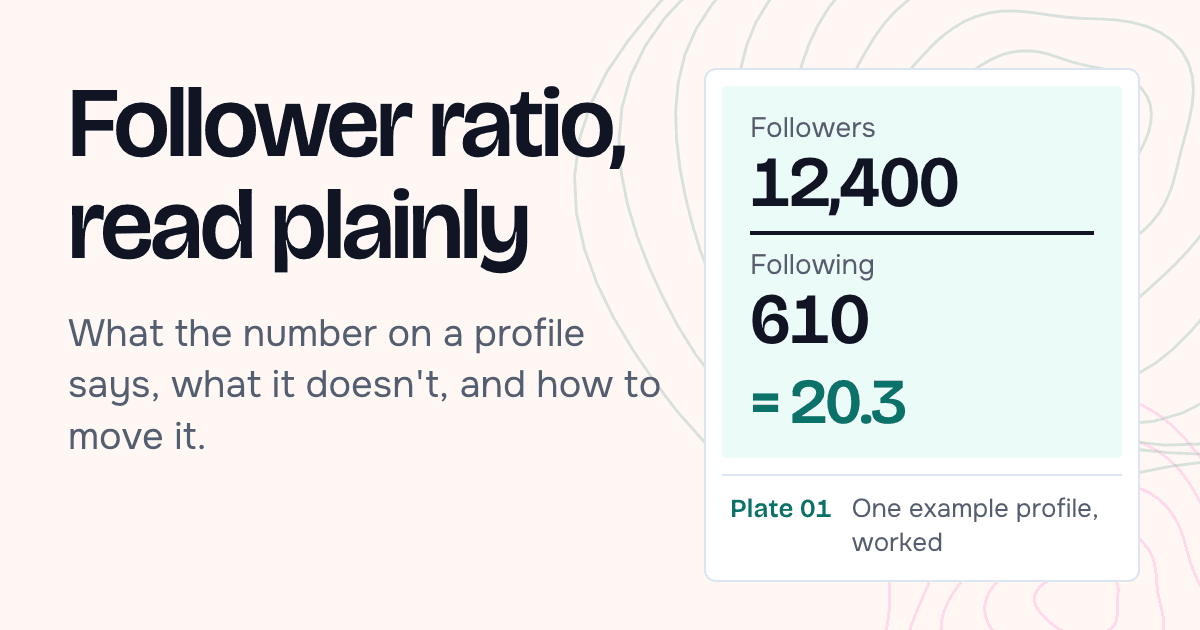
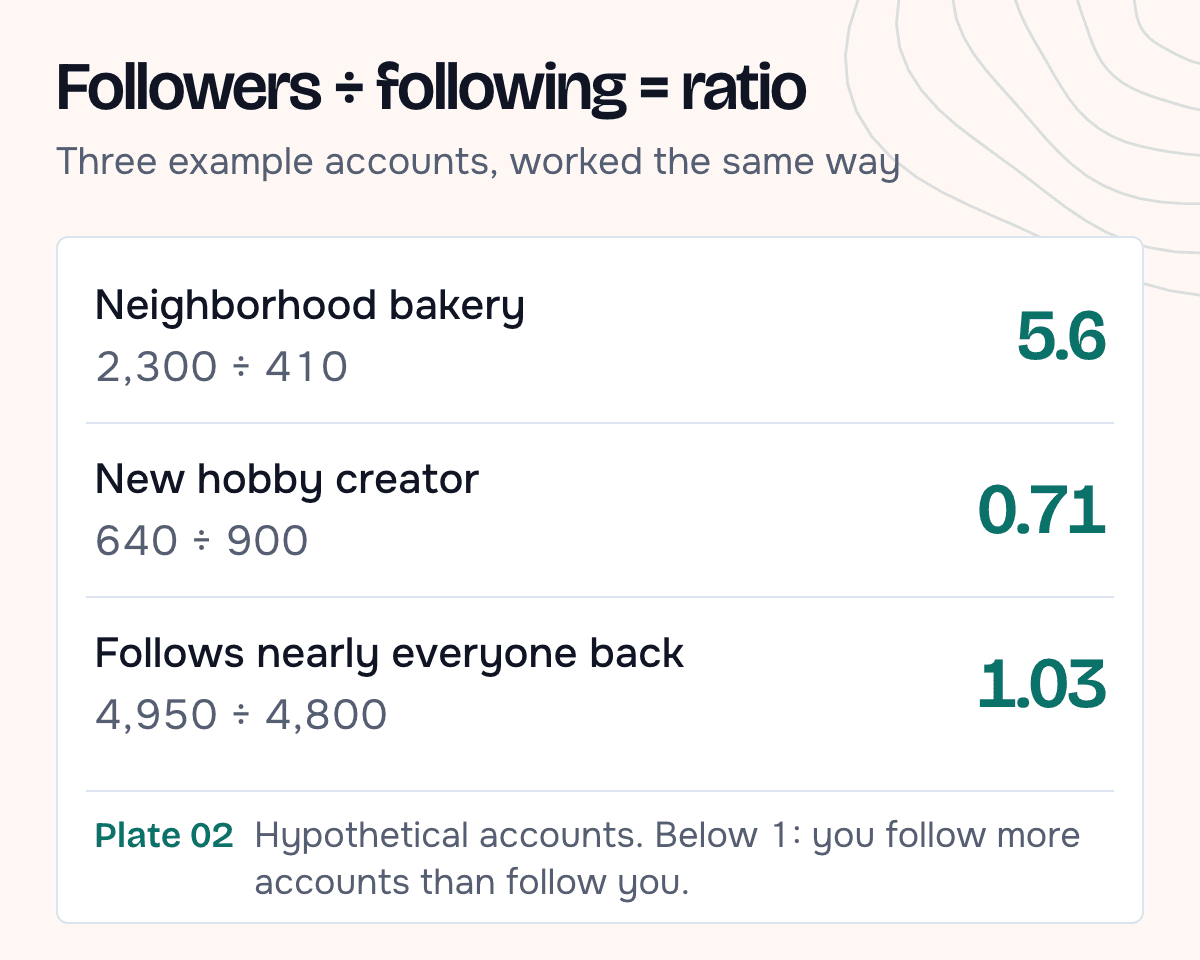
Your Instagram follower ratio is your follower count divided by the number of accounts you follow. 2,300 followers and 410 following gives 5.6. Instagram doesn't use that number to rank your posts, and no official "good" ratio exists. People still read it, though. A visitor deciding whether to follow you and a brand deciding whether to pay you both glance at those two numbers on your profile before anything else.
This guide shows how to work out your ratio, how people tend to read it, what Instagram says about ranking, and how to move the number without the shortcuts that get accounts cleaned up.
How to calculate your follower ratio
Open your profile. You'll see two numbers next to your posts count: Followers and Following. Divide the first by the second.
Followers ÷ following = ratio.
A few things trip people up:
- The order matters. Some articles flip it and talk about a "following-to-follower" ratio. If someone quotes a ratio below 1 as healthy, check which way round they divided.
- Write it either way. 5.6 and 5.6:1 mean the same thing: about 5.6 followers for every account you follow.
- There's a ceiling on one side. Instagram doesn't let anyone follow more than 7,500 accounts, a cap it says exists to help reduce spam. So the denominator can't run away forever, but an account that follows 7,500 people needs 7,500 followers to reach 1.
What counts as a good follower to following ratio
Nobody can give you an official answer, because Instagram has never published one. What exists is a rough reading that people apply when they look at a profile. It's a shared habit with no rulebook, and it works better as three wide bands than as one target number.
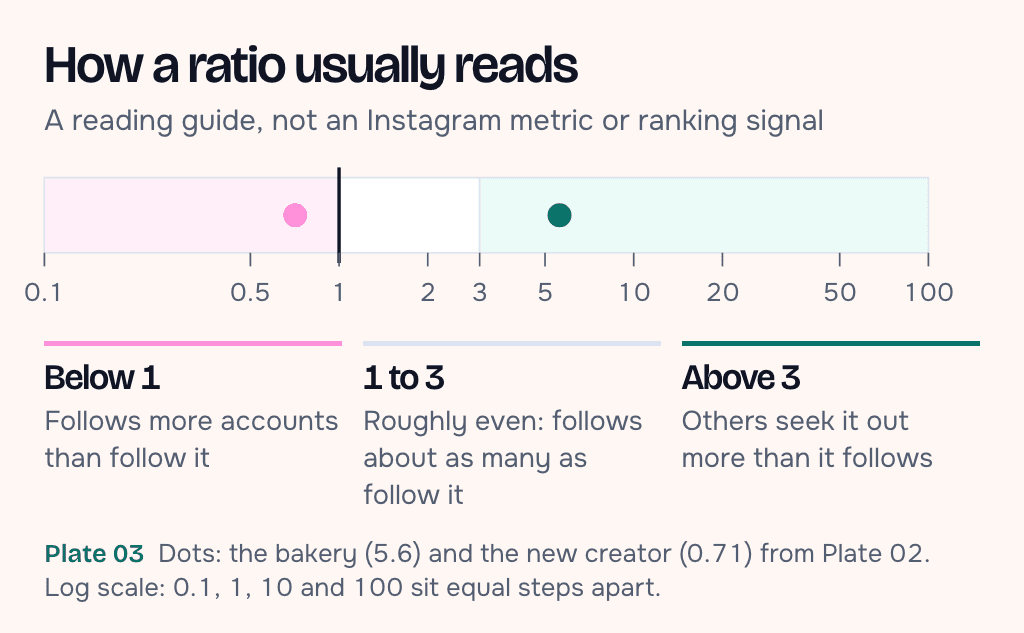
Below 1
You follow more accounts than follow you. For a personal account that mostly follows friends, artists and news, that's normal and nobody will think twice. For a new creator or a small business it can read as "follows lots of people hoping they'll follow back", especially when the following number sits in the thousands.
Between 1 and 3
Roughly even. When following is mostly mutual, as it is between friends, the ratio lands here by design. It says little either way, and it's a perfectly fine place for anyone who isn't trying to sell an audience.
Above 3
More people seek you out than you seek out. This is where you'd expect a brand or a public figure, and an account that follows almost no one can sit in the hundreds. A high ratio on its own proves nothing, though: a bought audience produces one too.
If you want a single goal, aim to stay above 1 and let the rest follow from what you post. Chasing 10:1 by unfollowing your friends mostly makes your feed lonelier.
Does Instagram's algorithm care about your ratio?
Not according to Instagram. Its head, Adam Mosseri, laid out the ranking signals in Instagram Ranking Explained in May 2023. Each part of the app ranks differently. Feed, for example, weighs your activity, information about the post, information about the person who posted, and your history with that person.
Follower count does appear, once. For Reels, Instagram says it considers "popularity signals such as number of followers or level of engagement" to help find content from a wide range of people. The number of accounts you follow is not mentioned anywhere on that page. Neither is the ratio between the two.
The signals that carry weight are about behavior: whether people watch, like, share and come back to what you post, and how often they've interacted with you before. Two accounts with the same ratio can get different reach, and a ratio that jumps overnight won't change anyone's feed.
Who looks at your ratio
People do, and they don't need your permission. On a public account, Instagram shows the follower and following lists to anyone on Instagram and Threads. Two groups pay the most attention.
New visitors. Someone who lands on your profile from a reel decides quickly whether to follow. A profile that follows 6,000 accounts and has 900 followers looks like it's fishing. A profile with a clear bio, a few strong posts and a ratio above 1 looks like it's worth a follow.
Brands. Instagram's own creator guide to branded content suggests that creators pitch with their number of followers and their average likes, views, comments and shares. That's the list a marketing manager will check, and the ratio is the quick sanity check before it. A brand that sees 20,000 followers and 7,400 following will wonder how many of those followers came from follow-for-follow.
The number brands check next: engagement rate
Engagement rate tells a brand whether your followers are paying attention. The common version divides the interactions on a post by your follower count. It's the method used by Quid (formerly Rival IQ) in its 2026 Social Media Industry Benchmark Report, which sampled 150 companies in each of 18 industries.
The median Instagram engagement rate in that report was 0.30% per post, down from 0.36% a year earlier. Those are company accounts, and a creator's audience behaves differently, so read the figure as a reference point.
To work out your own:
- Take your last 12 feed posts, skipping anything boosted with ads.
- Add up the likes and comments on each one.
- Divide each total by your current follower count and multiply by 100.
- Average the 12 results.
For example, a post with 210 likes and 14 comments on an account with 12,400 followers scores (210 + 14) ÷ 12,400 × 100 = 1.8%. To do the same for an account you're thinking of working with, the Instagram posts viewer shows the likes and comments on each of its recent posts without logging in.
Like-to-follower ratio
You'll also see "like-to-follower ratio" in pitch decks. It's the same calculation with likes only. It's quicker, and it ignores comments, which take more effort than a tap on a heart. Use it for a fast comparison, and the full engagement rate when money is involved.
Reels change the math
Reels reach people who don't follow you, so a reel's views can be many times your follower count. Dividing reel likes by followers can make a small account look extraordinary. When you compare reels, compare plays with plays. The Instagram reels viewer shows the play count and likes on each public reel, which makes it easy to see whether an account's reels travel beyond its followers.
How to improve your ratio without gaming it
The ratio has two moving parts. You control one directly and earn the other.
Prune who you follow
Open your Following list and go through it with one question: would I miss this account? Brands you followed for a giveaway, accounts that stopped posting years ago and people you can't place are easy cuts.
Do it in sessions over a few days rather than all at once. Instagram doesn't publish a daily limit, but a burst of hundreds of unfollows looks like the automated behavior its spam policy warns against, which includes "engaging with content… at very high frequencies".
Stop follow-for-follow
Following people so they follow back inflates both numbers and leaves you with an audience that never chose your content. It also caps out. At 7,500 following you can't follow anyone else, and you'll have a ratio near 1 built on followers who don't watch.
Post things people go looking for
Followers you didn't ask for are the only way the top number grows on its own. Reels are where non-followers find you, so a clear topic and a reason to save or share each reel matters more than posting often. For scale, Quid's report found company accounts averaged 3.7 Instagram posts a week.
Collaborate with accounts your audience would follow
A collab post or a guest appearance puts you in front of people who already like a similar account. Those followers chose you, and they tend to stay.
Never buy followers
Meta's spam policy bans "selling, buying, or exchanging for engagement, such as likes, shares, views, follows".
In the US, buying fake followers to look more influential for business reasons is also illegal: the FTC's rule on fake reviews and testimonials, in force since October 21, 2024, prohibits "selling or buying fake indicators of social media influence, such as followers or views generated by a bot or hijacked account".
Instagram has also said it removes inauthentic follows made through third-party apps. Followers who never engage also pull your engagement rate down, and that's the next number a brand reads.
Track your ratio month by month
A single ratio tells you where you stand. The trend tells you whether what you're doing works. Keep a note or a two-column spreadsheet and fill in one row on the first day of each month:
- the date
- followers
- following
- the ratio, followers divided by following
- Growth from Insights for the past 30 days, the followers you gained and lost
After three months, read the rows together. A ratio that rises while your follower count rises is the result you want. A ratio that rises only because the following column shrank means your cleanup worked and your content hasn't moved yet. If followers fall in a month where you posted a lot, look at what you posted before you change anything else.
Insights shows the Growth figure once you have at least 100 followers, and any public account can open it, personal or professional.
Checking someone else's ratio
Before you collaborate with an account, pitch to it or pay it, run the same math on it. You don't need to follow it or log in. The Instagram profile viewer shows any public account's follower and following counts and its bio. Divide one by the other, then look at its recent posts to see whether the likes match the audience size.
Three warning signs are worth a second look: a following count near 7,500, a follower count in the tens of thousands with a handful of likes per post, and a jump in followers that the account's posts don't explain.
FAQ
What is a good follower to following ratio on Instagram?
There's no official figure. Above 1 means more people follow you than you follow, which is what most visitors and brands look for. Above 3 usually reads as an account people seek out. Your engagement rate tells a brand more than the ratio does.
Does following a lot of people hurt my reach?
Instagram's ranking explainer doesn't list the number of accounts you follow as a signal. Following thousands of accounts mainly affects how your profile looks to people, and it fills your own feed with posts you don't care about.
How many accounts can you follow on Instagram?
7,500. Instagram blocks anyone from following more, whatever their follower count, and says the cap is there to reduce spam.
Should I unfollow people who don't follow me back?
Only if you don't want to see their posts. Unfollowing improves the ratio, but a feed you enjoy is worth more than a decimal point. If you do clean up, spread it over several days.
How do I calculate a ratio for an account I don't follow?
Look up its public profile, note its followers and following, and divide. For engagement, average the likes and comments on its last 12 posts and divide by its follower count.